Breathing Techniques for Instant Calm

Introduction: The Power at the Rhythm of Your Breath
Every single moment, without conscious thought, you breathe. It’s so automatic that most of us rarely stop to notice it—until it quickens in stress or slows in deep relaxation. Yet within this constant rhythm lies a hidden superpower. In as little as a few breaths, you can influence your mood, physiology, and mental clarity.
When you move from shallow chest breathing to intentional, rhythmic patterns, you signal safety to your body. You shift away from the high-alert “fight-or-flight” mode into a calmer, more centered state. National Geographic highlights one particularly effective method—the “physiological sigh,” a natural two-step inhale followed by a long exhale—that can lower stress in seconds. This isn’t mystical or abstract; it’s biology, and it’s something you can do anywhere—before a big meeting, during a tense conversation, or lying awake at night.
By understanding how breath works with your nervous system, you unlock a tool that is both ancient and cutting-edge—a portable, reliable way to bring yourself back to balance.
How Breath Calms the Nervous System
The Science Behind Slowing Down
Your breath is one of the few bodily processes that is both automatic and under your voluntary control. This makes it a unique lever for influencing your autonomic nervous system. When you slow and deepen your breathing, you stimulate the parasympathetic branch—the part responsible for rest, digestion, and repair.
Medical research shows that deliberate breathing can lower heart rate, reduce blood pressure, and ease muscle tension. The change is almost immediate: with every long exhale, your body begins to shift chemistry—reducing stress hormones like cortisol and allowing “feel-good” neurochemicals to flow more freely.
Rewiring Stress Through Breath
Emotions are not just mental experiences—they’re physical events. When you feel anxious, your breath becomes shallow and rapid, reinforcing your brain’s sense that danger is present. This creates a feedback loop: anxiety changes your breathing, which then tells your brain to be more anxious.
By flipping the script—slowing and deepening the breath—you send a signal of safety to the brain. Neuroimaging studies show that deliberate breath patterns can influence areas of the brain linked to emotional regulation, dampening activity in the amygdala (the brain’s alarm center) and enhancing activity in the prefrontal cortex, which supports rational thinking and emotional balance.
Rapid Techniques for Instant Calm
The Physiological Sigh: Nature’s Reset Button
The physiological sigh is one of the body’s natural reflexes for releasing tension—it often happens spontaneously when you cry or after a stressful moment. In a conscious practice, it works like this:
- Take a deep inhale through the nose until your lungs are almost full.
- Without exhaling, take a smaller second inhale to fully expand the lungs.
- Exhale slowly and completely through the mouth.
This method is remarkably effective for bringing down heightened stress in under a minute. The double inhale maximizes oxygen exchange, while the long exhale activates the parasympathetic response. It’s discreet enough to do at your desk or in a crowded room, making it a go-to emergency calm button.
Box Breathing: Grounding Through Structure
Box breathing—inhale for four counts, hold for four, exhale for four, hold again for four—is as simple as it is effective. The even timing provides a mental anchor, keeping your focus on the present moment and away from spiraling thoughts.
It’s widely used in high-pressure environments, from Navy SEAL training to professional sports, because it sharpens focus while calming the body. The gentle holds after inhalation and exhalation create a balanced oxygen-carbon dioxide exchange, which further enhances relaxation.
4-7-8 Breathing: A Natural Tranquilizer
Popularized by Dr. Andrew Weil, this technique is often recommended for calming pre-sleep jitters. You inhale for four counts, hold the breath for seven, then exhale slowly for eight counts.
The elongated exhale helps expel more carbon dioxide and encourages the nervous system to fully settle. Many people find it so relaxing that they feel drowsy within minutes—making it ideal for bedtime or winding down after a stressful day.
Resonance Breathing: Syncing Mind and Heart
Resonance breathing, sometimes called coherent breathing, involves inhaling and exhaling for equal lengths—typically around five or six seconds each. This rhythm harmonizes heart rate variability, a key marker of emotional adaptability and resilience.
Practiced consistently, it can help not only with stress but with long-term cardiovascular health. In 2025, it’s increasingly used in therapy and wellness programs to train both body and mind toward a naturally calmer baseline.
Alternate Nostril Breathing and Yogic Practices
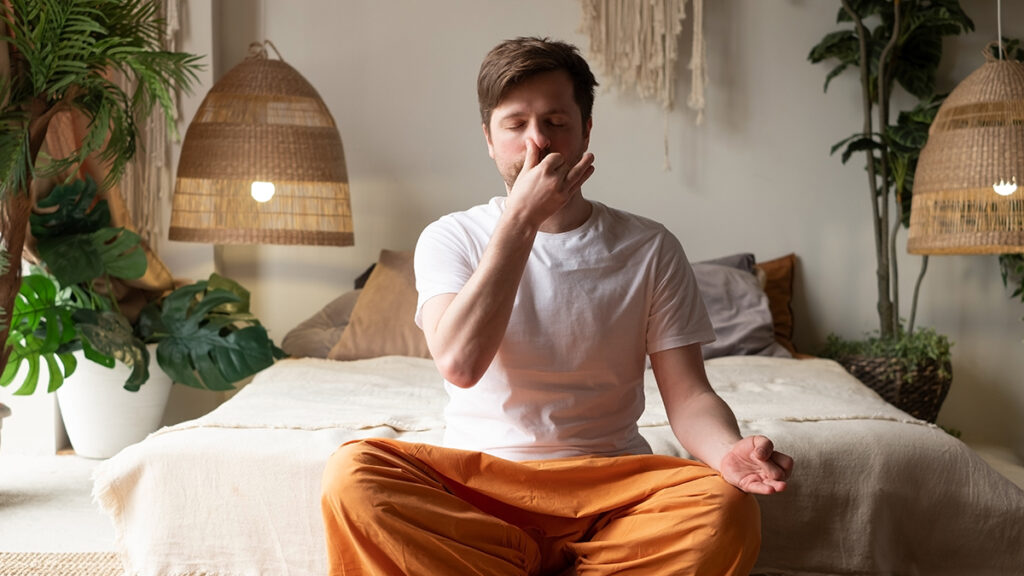
From the traditions of pranayama in yoga, alternate nostril breathing (Nadi Shodhana) offers a unique way to balance energy and focus. By consciously alternating inhalation and exhalation between the left and right nostrils, you engage both hemispheres of the brain, creating a sense of equilibrium and calm.
Other practices, like Bhramari—or humming bee breath—use gentle vibrations in the throat to stimulate the vagus nerve, which has a direct calming effect on the nervous system. These methods, though ancient, are now validated by modern science for their measurable impact on stress reduction.
Practical Integration of Breathing into Daily Life
The beauty of breathwork is its portability—it requires no equipment, no special setting, and very little time.
Picture this: you’re about to walk into a tense meeting. You pause in the hallway for two quick physiological sighs. Your shoulders drop, your jaw unclenches, and your thoughts become sharper. Later in the afternoon, after a barrage of emails, you set a timer for two minutes of box breathing to reset your focus. At night, lying in bed with your mind buzzing, you use 4-7-8 breathing to ease yourself toward sleep.
Even schools are recognizing the value. Programs like School Breathe teach children posture cues and nasal-focused breathing, helping them regulate emotions and attention. If a technique can calm an energetic classroom, imagine what it can do for your day.
When Breath Alone Isn’t Enough — Complementary Practices
Breathing is a foundation, but sometimes the body needs more cues to fully let go of tension. Pairing breathwork with other relaxation methods can amplify its effects.
- Gentle movement like yoga stretches or tai chi integrates breath with physical flow, deepening the sense of release.
- Progressive muscle relaxation (PMR) works especially well when tension is stubborn—tightening and releasing muscle groups while coordinating with slow exhalations.
- Habit stacking—linking breathwork to existing routines, like before meals or after closing your laptop—makes it easier to remember and sustain the practice.
The key is to see breathing not as a standalone event but as part of a lifestyle of mindful pauses.
Conclusion: Calm Begins with the Breath
Your breath is always with you, and it’s always listening. In moments of stress, it quickens; in moments of peace, it slows. By choosing to guide it intentionally, you reclaim a direct pathway to calm, clarity, and presence.
From the quick reset of a physiological sigh to the steady flow of resonance breathing, these techniques are evidence-based tools for living more intentionally. They require no special training, only willingness and a few moments of your attention.
Next time you feel tension rising, remember: your calm is only a few breaths away. The world might still be noisy, the demands still present—but within that rhythm, you carry an unshakable stillness, ready whenever you are.