Can AI Ever Be Truly Creative?

Introduction: The Creativity Conundrum in the Age of Artificial Intelligence
We live in a time when artificial intelligence can write poems, compose music, paint digital portraits, and even generate entire scripts for films or advertising campaigns. With tools like ChatGPT, Midjourney, and DALL·E producing content that often feels original, emotionally resonant, and surprisingly beautiful, it’s natural to wonder: Has AI truly become creative?
At first glance, the results can be astonishing. These machines can create images that feel inspired, write stories that evoke emotion, and generate music that sounds deeply human. But a deeper question lingers beneath the surface: Is this real creativity—or just the appearance of it? Are we seeing authentic innovation, or clever imitation stitched together by machines trained on vast amounts of human-made content?
This isn’t just a question for philosophers or tech theorists. It cuts to the heart of how we define human identity in a digital age. For centuries, creativity has been seen as a distinctly human trait—a spark of originality, a form of personal expression, and a reflection of lived experience. So if machines can replicate this, what does it mean for human creators? What becomes of artists, musicians, writers, and thinkers whose roles have long been defined by their creative spark?
In this article, we’ll explore the evolving relationship between AI and creativity. We’ll dig into how AI systems actually generate content, what separates imitation from innovation, and how our understanding of creativity might be changing. We’ll also look at the implications for creative industries—and ask the question at the center of it all: Can AI ever be truly creative, or is it just playing the part?
Understanding AI’s Creative Capabilities
The Mechanics of Machine-Generated Art
To really grapple with the question of AI and creativity, we first need to understand how these systems actually work. Most creative AI tools—whether they’re generating text, music, images, or videos—are built on deep learning models. These models are trained on enormous datasets made up of human-created content. They study patterns, mimic styles, and predict what comes next in a sequence to generate new material that looks and feels original.
Take a language model like GPT-4, for example. It doesn’t “decide” to write a story or poem. It doesn’t draw from life experience or wrestle with meaning. It’s simply calculating the most statistically likely next word based on the text it’s been trained on. Similarly, a tool like DALL·E creates images by learning how colors, objects, and visual compositions work across millions of pictures—and then remixing that knowledge to produce something new based on a prompt.
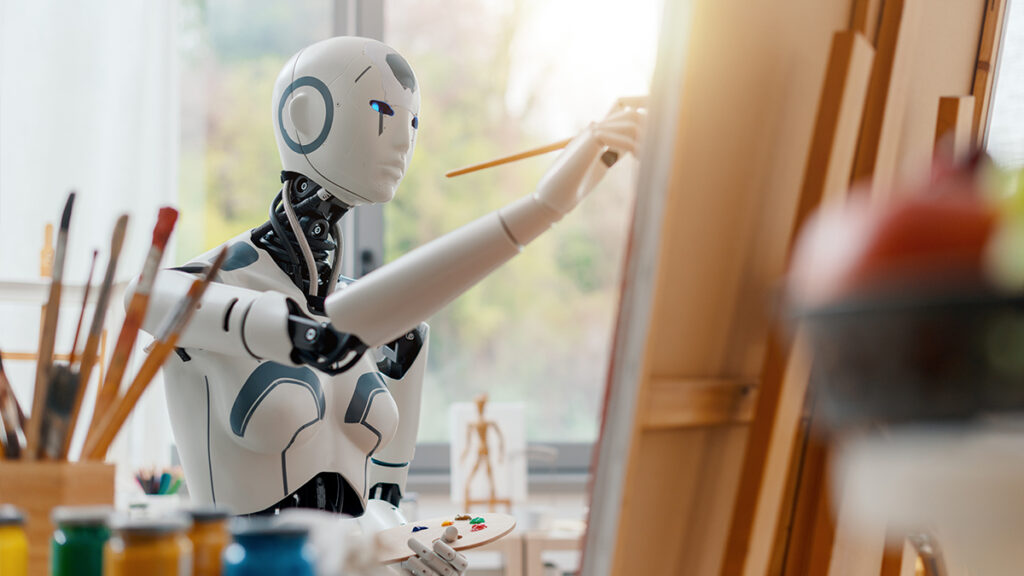
And yes, the results can be breathtaking. AI-generated art has won awards, been displayed in galleries, and even published in respected literary outlets. But here’s the catch: the machine has no understanding of what it’s creating. It doesn’t feel anything. It doesn’t know joy, sadness, fear, or awe. It’s not reaching for meaning—it’s calculating probability.
Creativity as Pattern Recognition vs. Conscious Innovation
Some argue that this isn’t so different from how the human brain works—that our creativity is just a form of advanced pattern recognition. After all, humans absorb experiences, ideas, and information from the world around them and combine them in new ways.
But critics of this view argue that human creativity involves something deeper. It’s not just about remixing what already exists—it’s about breaking patterns, challenging norms, and expressing a unique point of view. A truly creative work often feels disruptive, personal, or emotionally charged in a way that goes far beyond clever recombination.
In other words, AI may be able to imitate the look or sound of creativity, but it’s missing the core ingredients that give creative work its soul.
Defining Creativity: Beyond Output and Into Intent
Originality, Intent, and Emotional Depth
If we really want to evaluate whether AI can be creative, we first have to ask: What is creativity? Most definitions center on two core qualities—originality and meaning. A creative work isn’t just new—it resonates. It offers something insightful, emotionally rich, or culturally relevant. It moves us, challenges us, or changes how we see the world.
But creativity isn’t only about what’s made—it’s also about why it’s made. Human creators make art for reasons that go far beyond functionality. We write to process grief, to provoke change, to express love, to question power, or simply to connect. There’s an emotional and often deeply personal motivation behind creative acts—an inner fire that gives the work its meaning.
AI, however, doesn’t have motivations. It doesn’t create because it’s inspired or curious or outraged. Its “why” is entirely external—driven by a user’s prompt, a developer’s code, or a reward function. That lack of internal purpose separates AI from the kind of intentional creativity we associate with human artists.
The Role of Experience and Self-Awareness
Another defining trait of human creativity is that it’s shaped by experience. Artists often draw from their personal histories—their struggles, culture, traumas, dreams, and triumphs. This context adds layers of depth to their work that can’t be faked.
AI, on the other hand, has no memories. No emotions. No sense of self. It doesn’t evolve through experience. It can simulate emotional depth by mimicking human language or visuals, but it doesn’t feel anything. It doesn’t mean anything. And without that inner world, it lacks the raw material that fuels much of what we call creative genius.
In this light, AI might produce things that look creative—but it does so without any of the intention, feeling, or self-awareness that typically define the creative process.
Defining Creativity: Beyond Output and Into Intent
Originality, Intent, and Emotional Depth
If we really want to evaluate whether AI can be creative, we first have to ask: What is creativity? Most definitions center on two core qualities—originality and meaning. A creative work isn’t just new—it resonates. It offers something insightful, emotionally rich, or culturally relevant. It moves us, challenges us, or changes how we see the world.
But creativity isn’t only about what’s made—it’s also about why it’s made. Human creators make art for reasons that go far beyond functionality. We write to process grief, to provoke change, to express love, to question power, or simply to connect. There’s an emotional and often deeply personal motivation behind creative acts—an inner fire that gives the work its meaning.
AI, however, doesn’t have motivations. It doesn’t create because it’s inspired or curious or outraged. Its “why” is entirely external—driven by a user’s prompt, a developer’s code, or a reward function. That lack of internal purpose separates AI from the kind of intentional creativity we associate with human artists.
The Role of Experience and Self-Awareness
Another defining trait of human creativity is that it’s shaped by experience. Artists often draw from their personal histories—their struggles, culture, traumas, dreams, and triumphs. This context adds layers of depth to their work that can’t be faked.
AI, on the other hand, has no memories. No emotions. No sense of self. It doesn’t evolve through experience. It can simulate emotional depth by mimicking human language or visuals, but it doesn’t feel anything. It doesn’t mean anything. And without that inner world, it lacks the raw material that fuels much of what we call creative genius.
In this light, AI might produce things that look creative—but it does so without any of the intention, feeling, or self-awareness that typically define the creative process.
AI as a Tool for Human Creativity, Not a Replacement
Co-Creation and Augmentation
Rather than seeing AI as a threat to human creativity, many artists and technologists are choosing to see it as an opportunity—a tool to enhance, expand, and even inspire new forms of expression. Much like the invention of the camera changed painting, or digital software transformed music and graphic design, AI is the next evolution in the creative toolkit.
Writers are using AI to brainstorm story ideas or overcome creative blocks. Designers experiment with generative models to test hundreds of design variations in seconds. Musicians use AI to craft backing tracks or simulate full orchestras. In each of these cases, the machine supports—but does not replace—the human at the center of the process.
This is the model of co-creation, where AI works as a collaborator. The human provides vision, emotion, and judgment. The AI provides speed, pattern recognition, and endless possibilities. Together, they can explore new creative territories that neither could reach alone.
This also opens doors for people who may not have formal training. With the help of AI, more individuals can explore art, music, or writing, democratizing creativity in exciting new ways.
Risks of Overreliance and Homogenization
But this new collaboration comes with warnings. As more content is generated using the same models, trained on the same data, we risk a flattening of creativity. Art may begin to look similar. Stories may start to follow predictable beats. Music could feel increasingly formulaic.
There’s also pressure—especially in commercial settings—for creators to produce more, faster, and cheaper. This could sideline slower, more introspective forms of artistry in favor of quick-turnaround content designed to go viral. Over time, the unique, messy, deeply human parts of the creative process could get lost in the rush to scale.
So the challenge becomes finding balance. AI can absolutely help us explore creative potential—but we must be careful not to let it define what creativity means.
Ethical and Cultural Implications of AI-Generated Creativity
Ownership and Authorship in Machine-Made Art
As AI-generated content floods into the creative world, a thorny question keeps coming up: Who owns the art? If a person enters a prompt and an AI generates a song, painting, or story—who’s the rightful author? Is it the person who wrote the prompt? The developers who trained the model? Or no one at all?
Right now, most legal systems don’t recognize AI as a creator. That means if a piece of content is produced entirely by a machine, it may not be protected under traditional copyright laws. But this legal gray area creates confusion for artists, businesses, and consumers alike.
Even more troubling is the way these AI systems are trained. Many models are built using massive datasets that include copyrighted work—often without the knowledge or permission of the original artists. That means someone’s art, writing, or music could be scraped, analyzed, and replicated by a commercial AI system without any credit or compensation. This raises serious ethical questions about consent, ownership, and the value of creative labor in the age of automation.
Cultural Representation and Bias in AI-Generated Content
Another major concern is bias. Because AI learns from existing human-created data, it inevitably absorbs the dominant cultural perspectives—and the prejudices—that exist in that data. As a result, AI-generated content can reinforce stereotypes, overlook marginalized voices, and present a narrow view of the world.
This is especially troubling in creative contexts, where representation matters. If AI consistently replicates Western, male-centric, or heteronormative aesthetics and narratives, it can crowd out diverse perspectives and flatten cultural nuance.
For AI to have a meaningful and positive role in creativity, its development must include diverse training data, inclusive design principles, and transparency in how models are trained and used. Creativity should reflect the full range of human experience—not just the version that algorithms deem most “popular” or “relevant.”
The Future of Creativity in an AI World
Will AI Ever Develop Conscious Creativity?
Some technologists believe that as AI evolves, it might eventually cross into something resembling consciousness—or at least mimic it so convincingly that it feels real. If that happens, could machines become truly creative? Could they create not just by recombining data, but with intention, emotion, and vision?
The truth is, we don’t really know. Consciousness remains one of the biggest mysteries in science and philosophy. We don’t fully understand how it works in humans, let alone how—or if—it could ever emerge in machines. And without self-awareness, lived experience, or emotional depth, AI is fundamentally limited to imitation. It can mimic creativity, but it can’t truly mean what it creates.
Even if a form of synthetic consciousness were possible, it would likely be very different from human consciousness. Its “creative” expression might come from a completely alien logic or perspective—fascinating, perhaps, but not necessarily relatable or emotionally resonant in the way human art is.
A New Renaissance or a Creative Crisis?
The path we’re on now is filled with both promise and peril. Used thoughtfully, AI could help usher in a new creative renaissance. Artists could collaborate with machines to explore bold new styles, reach broader audiences, and push the boundaries of what’s possible in visual art, music, storytelling, and design.
But if we rely too heavily on AI for content—especially in pursuit of efficiency, profit, or speed—we risk triggering a creative crisis. Originality could be drowned out by repetition. Artists might be pushed aside by algorithmic convenience. And the value of deeply human expression—slow, imperfect, vulnerable—could be overshadowed by polished, predictable machine output.
The future of creativity in an AI-driven world isn’t set in stone. It will be shaped by the decisions we make now—about how we build, use, and regulate these tools, and about what we choose to value in art and in ourselves.
Conclusion: Creativity Beyond Code
At its core, the question of whether AI can be truly creative forces us to reflect on what creativity really means—and what makes it uniquely human. While AI can generate art that looks beautiful, music that sounds emotional, and writing that feels inspired, it does so without intention, emotion, or understanding. It doesn’t create out of joy or sorrow, curiosity or protest. It creates because it was told to.
What AI offers is not creativity in the human sense, but something else: powerful mimicry. It can simulate the aesthetics of creativity—sometimes brilliantly—but it cannot yet replicate the soul of it. And that soul often comes from lived experience, from emotional depth, from the messy, complicated human need to connect, question, and express.
That said, AI has earned a place in the creative world. It can inspire us, collaborate with us, and expand the boundaries of what we thought was possible. It gives more people access to creative tools, and it challenges long-held assumptions about authorship, artistry, and originality.
We are now painting on a bigger canvas—one that includes not just brushes and instruments, but algorithms and code. As we move forward, the question isn’t whether AI will replace human creativity, but how we’ll choose to integrate it into our creative lives.